




An eco friendly business card removes the paper waste, ink, and shipping involved in printed cards, and for a company with more than a handful of employees, that adds up to a measurable environmental impact. The environmental case for switching is not just a marketing angle, it is a straightforward reduction in material use that a business can actually track.
A standard box of printed business cards contains around 250 to 500 cards, and most professionals go through several boxes a year, especially in sales or client-facing roles. A large share of those cards are discarded within days, since the recipient either already has the contact saved elsewhere or simply forgets to keep it. Multiply that waste across a sales floor of twenty or thirty people and the paper use becomes significant over a single year, well before counting the ink, lamination, and packaging that go with each print run.
Paper Waste Reduction Starts With One Simple Swap
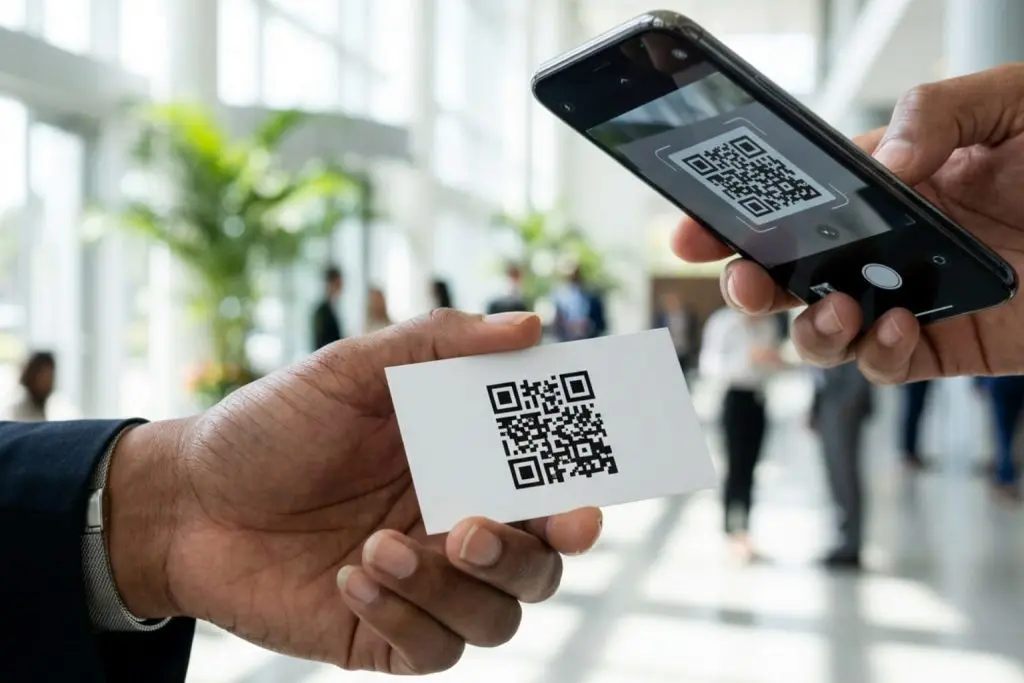
Paper waste reduction from switching to an eco friendly business card is easy to measure because the comparison is direct. No printed card means no paper pulp, no ink cartridge use, and no cardboard packaging shipped from a printer to an office. A sustainable business card exists entirely as a digital profile, accessed through a link, a QR scan, or an NFC tap, so the only physical resource involved is the phone the person already owns.
Corporate Sustainability Goals Now Include Small Operational Changes
Corporate sustainability goals used to focus mostly on large initiatives like energy sourcing or supply chain audits. Increasingly, companies are also tracking smaller operational choices, and switching every employee to a paperless business card is one of the easiest wins to report, since it requires no major infrastructure change and produces an immediate, visible reduction in printed material. Sustainability teams often list this switch alongside things like reducing paper in offices generally or moving internal documents to digital formats.
Estimating a Company’s Carbon Footprint From Printed Cards
A basic carbon footprint calculator applied to business cards factors in the paper source, the printing process, and the transportation involved in getting cards from a print shop to an office. While the footprint of a single card is small, the combined impact across an entire sales team, marketing department, or company-wide rollout is not trivial, especially for companies with hundreds of employees who reorder cards multiple times a year as staff change roles or contact details update. Green networking tools remove this recurring footprint entirely, since a digital card only needs to be created once and then edited as needed with zero reprint cost or waste.
If your company is calculating the impact of a full switch, you can see how a paperless setup works by visiting www.shareecard.com and comparing it against your current print reorder cycle.
Eco Conscious Branding Resonates With Clients Too
Eco conscious branding is not only an internal metric, it is also something clients and partners notice. A company that hands out a digital business card instead of a printed one is making a small but visible statement about how it operates. For businesses in industries like real estate, consulting, or professional services, where trust and image matter in a first meeting, this detail can quietly reinforce a modern, responsible brand image without needing to say anything explicitly about sustainability.
A Realistic Way to Make the Switch
Companies do not need to eliminate paper cards overnight to see a benefit. A phased switch, starting with the sales or marketing department and expanding from there, lets a business measure the paper and cost savings directly before rolling out company-wide. Most teams find that once employees experience how much faster a digital business card is to share and update, the printed version becomes unnecessary within a few months rather than something that needs to be forced.
FAQs
How much paper does a mid-sized company actually save by switching? It depends on team size and reorder frequency, but a company of fifty employees reordering cards twice a year can eliminate tens of thousands of printed cards annually by switching to a digital format.
Does a digital business card have any environmental cost at all? The environmental cost is limited to the small amount of energy used to load a webpage, which is negligible compared with the paper, ink, and shipping involved in producing and distributing printed cards.
Can a business highlight this switch in its sustainability reporting? Yes. Many companies list the move to digital business cards as a concrete, easily quantified step in their sustainability reporting, since the before-and-after paper reduction is simple to document.
The environmental case for an eco friendly business card is one of the rare sustainability changes that saves money and reduces waste at the same time, which is why more companies are treating it as a default rather than an optional upgrade.






Leave a comment