




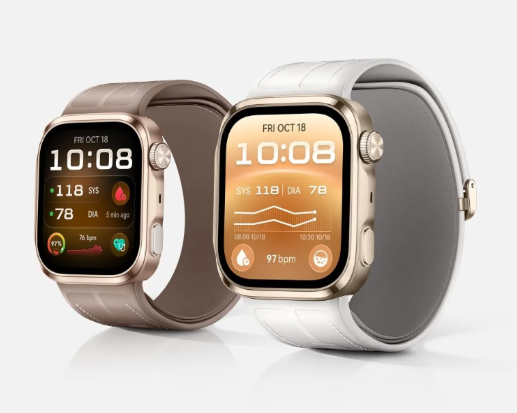
A surprising number of people discover that their blood pressure behaves differently depending on who is measuring it. Readings climb the moment a clinical setting appears — a phenomenon known as white coat hypertension — while others show the reverse pattern, appearing normal at appointments yet running high through ordinary days, a quieter problem called masked hypertension. Both patterns can mislead, and both share a common solution: measuring blood pressure where life actually happens. Wrist-worn monitors such as the HUAWEI WATCH D3 have made that idea practical for the first time.
When the Surgery Skews the Numbers
The clinical environment is a peculiar place to gauge anything about daily life. Anticipation, mild anxiety, the rush to make the appointment on time — each can nudge a reading upward, sometimes substantially. For decades the dilemma was circular: the measurement setting distorted the measurement, yet the measurement was all anyone had.
Masked hypertension presents the opposite trap. Reassuring readings in the consulting room can conceal elevated pressure during stressful commutes, demanding meetings or poor nights of sleep — the very hours when cardiovascular strain accumulates. Neither pattern can be detected from occasional clinic checks alone.
The Case for Measuring at Home and Beyond
Home monitoring solved part of the puzzle, giving people a way to record readings in familiar surroundings. Yet traditional upper-arm devices come with their own limits: they sit in a cupboard most of the day, depend on the wearer remembering to use them, and capture only deliberate moments rather than the full rhythm of a week.
A wrist-based approach removes that friction entirely. With the measuring hardware built into a watch worn from morning to night, readings happen in context — before breakfast, after a difficult call, during a quiet Sunday afternoon. The resulting picture reflects real life rather than a performance of it.
Accuracy remains the foundation beneath all of it. The WATCH D3 measures with the oscillometric method — the same principle behind conventional clinical devices — implemented through an innovative mechanical airbag and high-precision pressure sensor, and certified as a medical device under CE-MDR. Home data only earns its place in medical conversations when it can be trusted.
From Suspicion to Confirmation: Working With a GP
Home data reaches its full value when it enters the consulting room. Arriving with weeks of readings — or better, a structured twenty-four-hour ambulatory report — changes the appointment entirely: instead of a single nervous measurement and a guess, the discussion begins from daytime and night-time averages, pulse trends and documented context.
Clinicians welcome this shift. Decisions about starting, adjusting or ruling out treatment depend on trustworthy information, and a CE-MDR-certified device producing consistent home records provides exactly that. The watch does not replace professional judgement; it equips it.
Choosing the Right Moments to Measure
Not all hours are equally informative. Readings taken in the calm of early morning and the wind-down of evening tend to be the most stable and comparable, while measurements immediately after meals, caffeine, exercise or stressful events capture transient peaks that mean little in isolation. Building the routine around those two anchor points — morning and evening — creates a clean baseline against which everything else can be judged.
Occasional spot checks at other times still have their place: a reading after a difficult meeting or before a workout adds context that the baseline lacks. The art lies in knowing which numbers represent the underlying condition and which merely describe the moment.
Twenty-Four Hours of Honest Data
The deepest version of this picture comes from ambulatory monitoring: automated readings at intervals across a full day and night. Clinical guidelines recommend exactly this approach for confirming diagnoses, precisely because it defeats both white coat elevation and masked hypertension in one design.
The WATCH D3 runs such plans from the wrist, using a mechanical airbag and high-precision pressure sensor to take automatic readings — including during sleep — and compiling them into a professional report of daytime, night-time and twenty-four-hour averages. Generating that report to share with a GP turns the next appointment into a conversation grounded in evidence rather than estimation.
Building a Calm Measuring Routine
Good home data still depends on good habits. Measuring at consistent times, resting for a few minutes beforehand, keeping the wrist at heart level and avoiding caffeine or exercise immediately prior all improve reliability. Smart reminders on the watch can carry the burden of scheduling, prompting one-off or recurring checks that fit naturally into the day.
Over weeks, the routine stops feeling like a chore and becomes a quiet ritual — a moment of attention that, multiplied across a season, produces a dataset no clinic visit could assemble.
Understanding What the Readings Mean
Collecting numbers is only half the task; interpreting them well completes it. Activity, stress, meals and sleep all leave signatures on blood pressure, and learning to read those signatures prevents both complacency and needless alarm. This specialist-written guide to exercising with a smartwatch bp monitor explains how context shapes readings and which patterns genuinely deserve professional attention — essential background for anyone building a home-monitoring habit.






Leave a comment